Outdoor Lighting Company in Columbia, TN: Design Zones, Layering and What Gets Lit
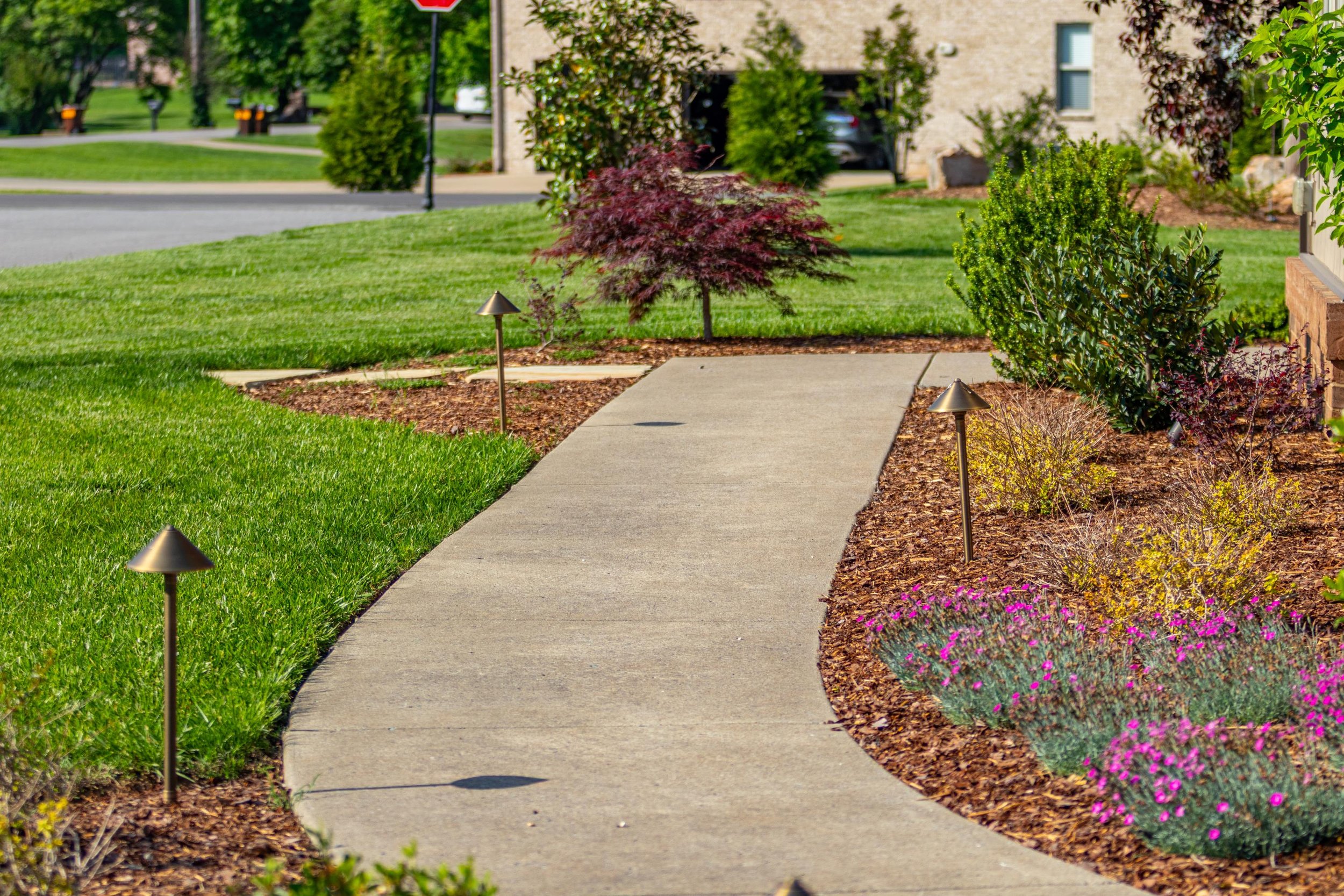
A property in Maury or Williamson County reads as a completely different place at nine in the evening than it does at noon, and the difference is rarely an accident. An outdoor lighting company in Columbia, TN earns its keep during the design stage, walking your property after dark and deciding where light belongs before a single fixture is priced.
Our team maps how you actually move across the property at night, which features deserve attention, and which corners read better left quiet. That map turns into zones, and the zones drive fixture counts, cable routing and transformer sizing. This guide covers the way we plan lighting for Middle Tennessee properties, what gets lit and why, and how a lighting layer drops into a landscape that has already grown in.
Niedergeses Landscape has worked across Middle Tennessee since 1990, when Jayme Niedergeses grew a teenage mowing route into a full landscape company, and the business has stayed licensed and insured every year since.
Lighting sits inside our design and build practice rather than off to one side of it. The crew setting fixtures is the same crew that knows where the irrigation lateral runs, how deep the beds sit and which trees were planted three seasons ago.
Related: The Secret to Stunning After-Dark Living: Outdoor Lighting in Forest Hills and Belle Meade, TN
What Does an Outdoor Lighting Company Do Before Any Fixture Goes in the Ground?
The work starts with a night visit, a notepad and a handful of temporary fixtures on extension leads. Daylight hides the two things that decide a lighting plan: where the existing darkness sits and where glare already comes in off the street, the garage doors and the neighbors.
We walk the arrival route, the entry, the back terrace and the property edges, then mark the trees and walls worth pulling forward.
From that walk we produce a zone drawing, a fixture schedule and a wire plan. The zone drawing shows which groups of fixtures share a run and a switch leg. The fixture schedule lists type, lumen output, beam angle and mounting detail for every position.
The wire plan sets cable gauge, run length and transformer location so the last fixture on a run sits within the voltage window the manufacturer specifies.
How Many Lighting Zones Does a Property Need?
A typical half acre suburban lot in Columbia or Spring Hill lands between four and six zones, and larger rural parcels around Arrington and College Grove often run eight or more. Zones are not the same thing as circuits. A zone is a piece of the property with one job, and grouping fixtures by job is what keeps a layout from turning into a scatter of bright dots.
The zones we lay out most often
Arrival covers the driveway, the parking court and the point where headlights stop being useful. Entry covers the walk, the steps and the front door, which is the one zone guests judge you on. Circulation covers side paths, grade changes and the route to the back terrace. Gathering covers the patio, the seating wall and the fire feature, and it usually runs at the lowest output on the property.
Feature lighting is the fifth zone: the specimen maple, the limestone outcrop, the stacked wall face with real texture in it. The perimeter comes last and stays deliberately thin, because a lit fence line flattens everything inside it. On properties with a pool or a pond we treat water as its own zone with its own control, since water reflects roughly double what the eye expects.
What Should Be Lit in a Yard, and What Should Stay Dark?
Light the surfaces people walk on, the objects worth looking at, and nothing else. Contrast is the whole point of a night landscape, and contrast disappears the moment every square foot gets the same treatment. The restraint is what separates a designed property at night from a parking lot.
Worth lighting
Steps, grade changes and any transition where a stone edge meets turf belong on the list for plain safety reasons. Specimen trees with structure worth showing, such as an older red maple or a multi trunk crape myrtle, take an uplight beautifully. Walls with texture, stone columns, water features and the front door surround all reward a fixture. So does a paver terrace edge, where a low wall light washes the surface without putting anything at eye level.
Better left dark
Open lawn takes light poorly and gives nothing back. Fence lines and property boundaries pull the eye outward and shrink the yard. Anything aimed at a window, yours or a neighbor's, becomes a complaint by the second week. Uplights under a thin canopy throw straight into the sky and waste the output entirely, which is why we check canopy density in leaf and out of leaf before committing to a tree position.
How Bright Should Outdoor Lighting Be?
Far dimmer than most people guess. Path fixtures generally sit between forty and one hundred twenty lumens, wall and step lights between twenty and eighty, and an uplight on a mature oak between two hundred and six hundred depending on trunk height and bark color. The eye reads relationships, not absolutes, so a modest fixture in a dark yard looks brighter than a large one on a washed out street.
Two mistakes account for most of the bad lighting we get called out to fix. The first is the runway effect, where identical path lights march down a walk at even spacing and turn the approach into an airfield. Staggered spacing at ten to fifteen feet, with a gap where a planting mass does the work instead, reads far better. The second is over lighting the gathering space, which flattens faces and kills the reason people sit outside after dark.
Dimming matters as much as fixture selection. Modern low voltage systems support output trimming at the transformer or at the fixture, so a layout that felt right in October stays right in July once foliage fills in and reflects more light back at the terrace.
What Color Temperature Suits Landscape Lighting in Tennessee?
Warm white at 2700K carries most Middle Tennessee properties, because the region's building materials run warm. Red brick, Tennessee limestone, cedar and stained hardwood all sit in warm tones, and a cooler lamp turns them grey. On white painted trim, board and batten and modern facades, 3000K holds the color without going yellow.
Cooler output around 4000K has a narrow but real use: blue spruce, silver foliage, water and stone with grey tone. We use it sparingly and we keep it away from anything the warm zones touch, because two color temperatures in the same sightline read as a mistake even to people who could not name why.
Consistency across a property matters more than the exact number. Mixed color temperature is the most common flaw we find in yards where fixtures were added a few at a time over several seasons.
Related: Set the Scene With Proper Outdoor Lighting in the Franklin and Brentwood, TN Areas
Does an Outdoor Lighting Layer Work in an Established Landscape?
Most of our lighting work goes into landscapes that are already ten or twenty years old, and an outdoor lighting layer works well in an established landscape. A mature property is easier to light well than a new one, because the plant structure already exists and we are reading real forms rather than guessing at what a shrub will become.
The practical work is cable routing. In established beds we hand trench six to eight inches through mulch and topsoil, following bed lines rather than cutting across them, and we sleeve under walks and drives with a boring rod instead of opening the surface. Around mature tree root plates we route outside the drip line where possible and hand dig where it is not.
Two site conditions slow this down in our market. Shallow limestone shows up across Maury County at less than a foot in places, which pushes cable into planted beds and along wall bases. Heavy clay holds water in low spots, so we keep splices and transformer bases above the wet line and coordinate the routing with any drainage work already in the ground.
Retrofitting also means working around irrigation installed years earlier. Locating heads and laterals before trenching is routine for us because we install and service those systems too.
Layering a Yard: Three Heights That Make a Property Read at Night
Depth at night comes out of working three heights at once. A yard lit at one height looks flat no matter how many fixtures go in.
Ground level
Path lights, step lights, wall wash and hardscape fixtures under a seat wall cap belong here. This layer does the safety work and defines the shape of the ground plane. Keep the output low and the source hidden, so people see lit surfaces rather than bright objects.
Mid level
Bed lighting, shrub grazing, column lights and short uplights on ornamental trees sit in the middle. This is where the planting design becomes visible after dark, and it is the layer most often missing in yards that were lit by a fixture kit rather than a plan. A hydrangea mass or a line of dwarf boxwood grazed at a shallow angle gives a property its body at night.
Upper level
Downlighting mounted twenty to thirty feet up in a mature hardwood casts dappled light across a terrace and reads as moonlight. It is the layer that turns a lit yard into a place people want to sit. Mounting hardware has to allow for trunk growth, so we use expandable straps rather than lag bolts and revisit the mounts on service visits.
Local Conditions That Shape a Lighting Layout in Maury and Williamson Counties
Middle Tennessee puts a specific set of pressures on a lighting system. These are the conditions we design around on nearly every property.
Rock, clay and water
Shallow limestone ledges appear across Columbia and Mount Pleasant, often within eight inches of grade. Cable routing follows bed lines and wall bases where the digging is realistic. Dense clay soils hold water for days after a storm, so transformers get mounted above grade on a wall or a post and connections stay out of standing water. Low areas that pond during summer thunderstorms need grading resolved before fixtures go in, not after.
Canopy, growth and the mowing crew
Mature oaks, maples and hackberries change a lighting plan twice a year. A tree uplight aimed correctly in March throws half its output into the sky by June, so we set beam angles for the leafed condition and accept the winter difference. Fast summer growth buries path fixtures in perennials, which is why we set them at the front edge of a bed with a clear collar around each stem.
String trimmers and mower decks account for more fixture damage in this market than weather does. Setting fixtures four to six inches back off a mowing edge, and using a solid brass or cast body rather than thin aluminum, removes most of that problem before it starts.
Why a Design and Build Team Handles Outdoor Lighting Differently
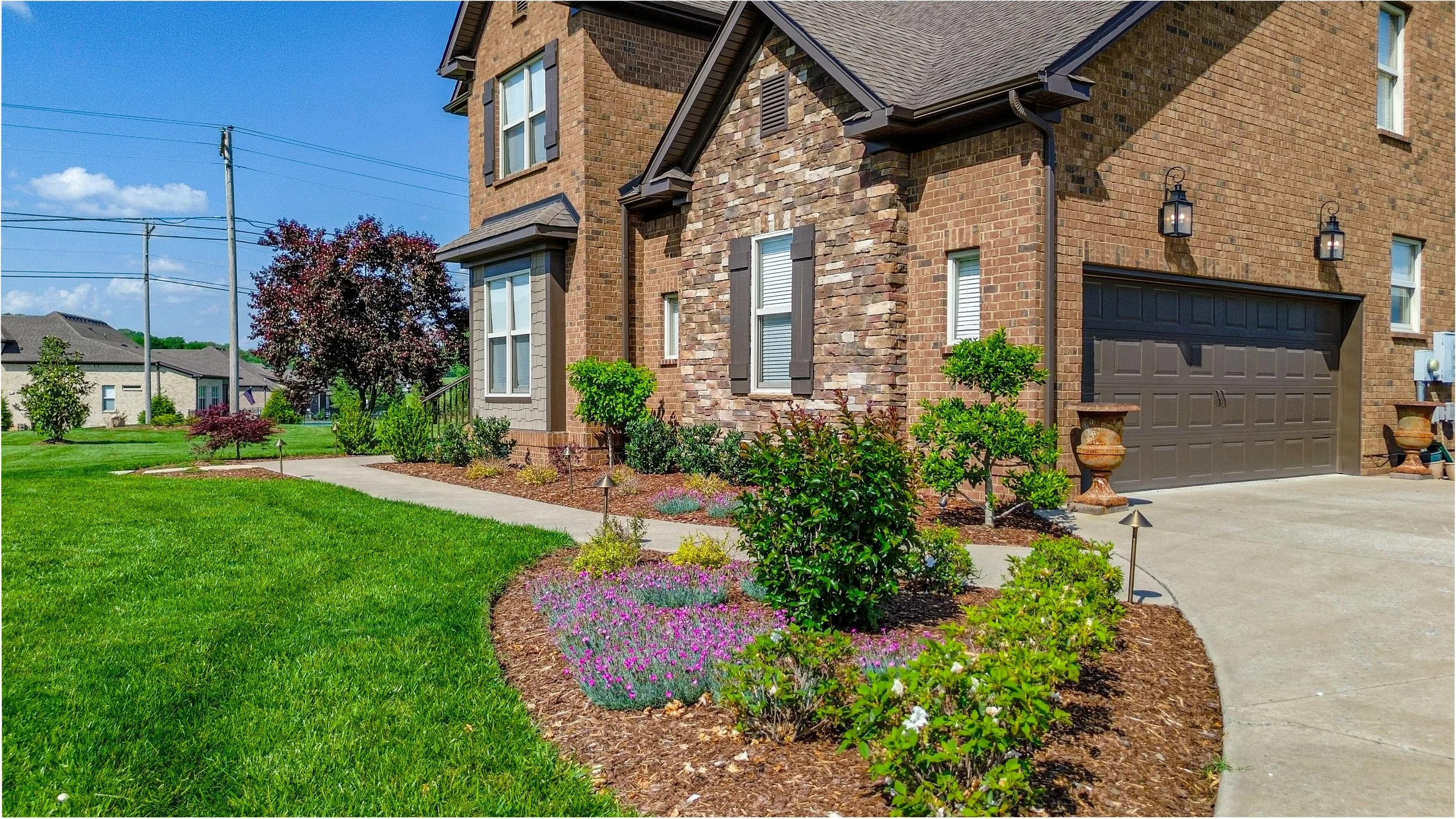
A lighting only contractor arrives after the landscape is finished and works around whatever is already buried. A design and build team sets the lighting plan while the site is still open, which changes what is possible and what it costs.
On new construction and renovation projects we sleeve conduit under patios, walks and driveways before pavers are set. Fixture positions get marked during layout, so wire is buried during the same excavation that puts in the base. Uplight positions at specimen trees are set while the planting plan is still on paper, which means the tree goes in at the spacing the lighting wants rather than the reverse.
It also changes service. One team holds the record of what is buried where, so a call about a dark run does not turn into an excavation. Our crews work out of Columbia and cover Spring Hill, Thompson's Station, Franklin, Brentwood, College Grove and Arrington.
The renovation work we do most often, tearing out a tired landscape and rebuilding it properly, is exactly where lighting pays off hardest, and it is the same thinking behind a backyard built as an extension of the house.
Plan Your Lighting Design with Niedergeses Landscape
If your property goes dark and featureless at sunset, the fix starts with a night walk and a zone plan, not a box of fixtures.
Our team designs and installs low voltage landscape lighting across Columbia, Spring Hill, Thompson's Station, Franklin, Brentwood, College Grove and Arrington, and we handle the trenching, the transformer, the controls and the annual service that keeps a system aimed correctly.
Reach out to our office in Columbia to schedule a lighting design visit, and let Niedergeses Landscape build the outdoor lighting layer your landscape has been waiting for.
In Summary: Quick Answers on Outdoor Lighting Design
How many fixtures does a typical property need?
Most half acre properties in our service area land between eighteen and thirty five fixtures across four to six zones. Larger rural parcels run higher. Fixture count follows the zone plan rather than setting it, and a well placed twenty fixture layout typically outperforms a scattered forty.
Does landscape lighting work with an existing irrigation system?
It does, provided someone locates the heads and laterals first. We map the irrigation layout before trenching and route cable along bed lines where the two systems stay clear of each other.
How often does an outdoor lighting system need service?
Once a year covers most properties. An annual lighting service visit re aims fixtures that plant growth has blocked, cleans lenses, checks connections and resets timers for the seasonal shift. Ice loading in January and spring winds bring branches down on tree mounted fixtures, so we build a service loop into every mount and inspect them on the same visit.
Is lighting worth adding to a landscape we already like?
Lighting is generally the highest impact addition to a mature landscape that homeowners already like. The structure is already there, so lighting is the layer that makes it visible during the hours most people are actually home to see it.
Related: Upgrade Your Outdoor Space With Outdoor Lighting & Paver Walkway in Unionville, TN
About the Author
In 1990, at just 14 years old, Jayme Niedergeses took the first step in starting his own company when he started mowing lawns around his hometown. From that one-man lawn-mowing operation grew a reliable, full-service landscaping company that serves the entire Middle Tennessee Area. Niedergeses landscapers are fully licensed, insured, highly trained, and extensively experienced. Every full-time and seasonal member of our crew is dedicated to providing excellent customer service as they create and care for beautiful landscapes.