Retaining Wall Materials, Drainage, and Design: What Middle Tennessee Homeowners Should Know
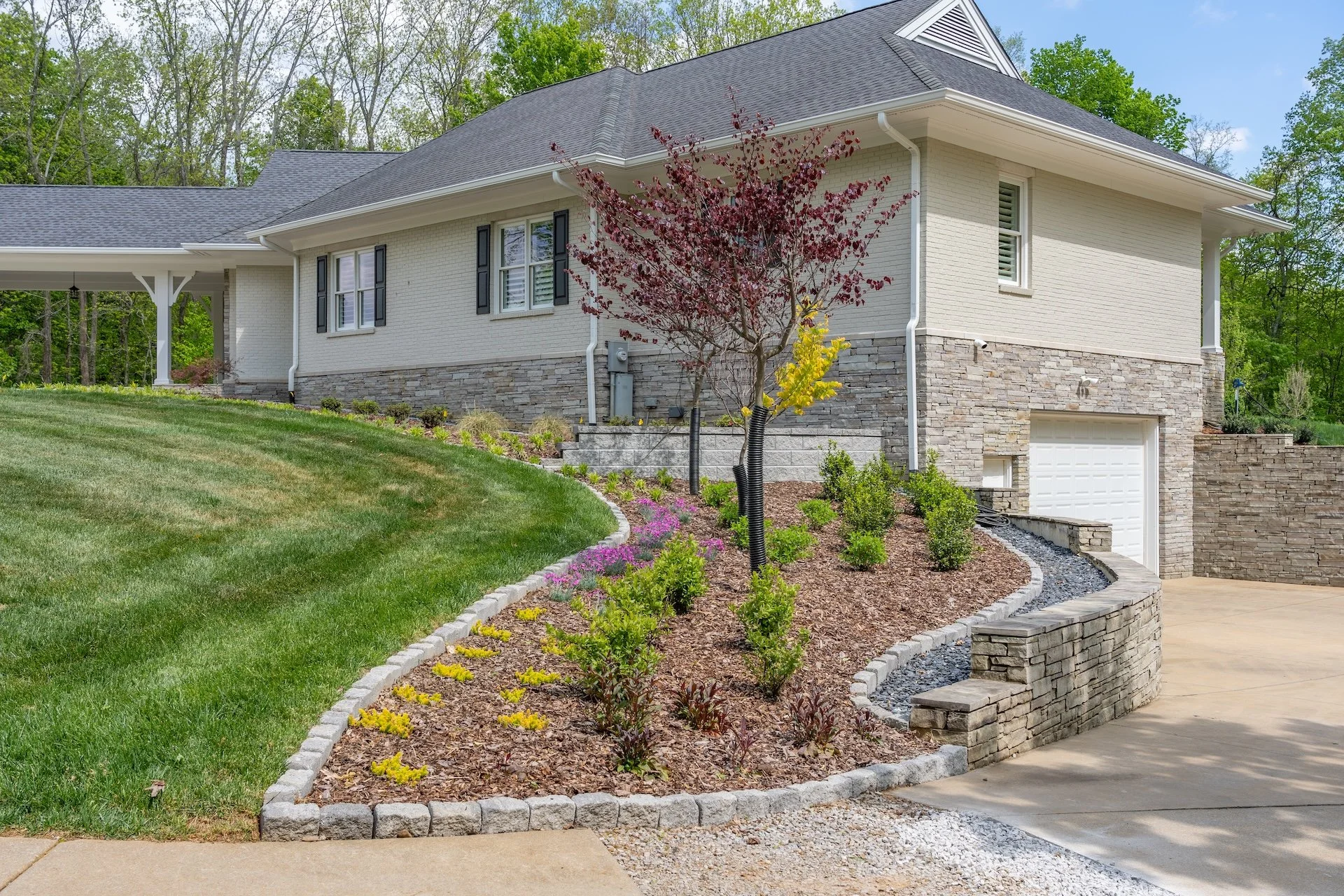
A retaining wall solves a problem that most homeowners do not fully understand until the problem gets worse. The yard slopes. Water pools where it should not. Soil creeps downhill after every heavy rain. A section of the lawn that used to be flat is starting to tilt. The flower bed along the back fence is washing out. The patio feels like it is slowly losing ground.
These are not cosmetic issues. They are structural ones. And a retaining wall, when it is designed and built correctly, addresses all of them while creating usable space, visual definition, and long-term stability on a property that the slope was steadily taking away.
But not every retaining wall is the same. The materials, the drainage behind it, the base preparation underneath it, and the way it connects to the rest of the landscape all determine whether the wall holds up for decades or starts leaning within a few years. For homeowners in Columbia, TN, and across Middle Tennessee, where clay soils, seasonal downpours, and rolling terrain are part of every property, those details matter more than most people expect.
This guide covers the decisions that go into a retaining wall that actually works.
Related: Create, Contain, and Conquer Your Yard’s Terrain with Retaining Walls
The Problem a Retaining Wall Is Really Solving
Before talking about materials or design, it helps to understand what a retaining wall is actually doing from an engineering standpoint.
It is holding back the lateral earth pressure.
Soil on a slope wants to move downhill.
Gravity pulls it. Water accelerates it.
Freeze-thaw cycles loosen it.
Root systems shift it.
Over time, that movement creates erosion, grading problems, and damage to anything built on or near the slope.
A retaining wall interrupts that movement. It creates a vertical or near vertical face that holds the soil in place and allows the grade to change over a shorter horizontal distance than the natural slope would require. That is how a sloped, unusable hillside becomes a flat, functional terrace. It is how a driveway stays level instead of slowly sliding toward the house. It is how a patio built at the base of a grade does not spend every spring buried under a layer of washed-out mulch and sediment.
The wall is not a decoration. It is doing real work against real forces. And the amount of force it needs to resist depends on the height of the wall, the type of soil behind it, the water pressure that builds up during rain events, and the weight of anything sitting on top of the retained area. All of those factors influence the design.
How Middle Tennessee Soil and Climate Affect the Build
The soil across most of Middle Tennessee is heavy with clay. Clay soils hold water instead of draining it. When they get wet, they expand. When they dry out, they contract. That cycle of expansion and contraction puts constant lateral pressure on any structure built against them, including a retaining wall.
This is one of the main reasons walls fail in this region. The wall itself might be built with good materials and proper technique, but if the drainage behind it does not account for how clay soil behaves when it is saturated, the water has nowhere to go. Hydrostatic pressure builds behind the wall. The soil swells. And over time, the wall starts to lean, crack, or push outward at the base.
Middle Tennessee also receives significant rainfall, particularly in the spring. When several inches of rain fall over a few days, every slope on the property is under stress. Water runs downhill across the surface and also moves through the soil itself, following the path of least resistance. If that path leads to the back of a retaining wall with no drainage system in place, the wall absorbs the full load.
Temperature swings between seasons add another variable. While Middle Tennessee does not experience the deep frost cycles of the northeast, it does see enough cold weather to affect soil behavior and material performance. Mortar joints in natural stone walls can crack if water gets in and freezes. Block walls with poor cap adhesion can shift when temperatures swing rapidly. These are not catastrophic events individually, but they compound over years if the wall was not built to handle them.
Materials: What to Build With and Why It Matters
The material you choose for a retaining wall affects its appearance, its structural capacity, its lifespan, and how it integrates with the rest of the landscape. There is no single best option. There is only the right option for the specific project.
Segmental retaining wall block is the most common choice for residential walls in this region. These are engineered concrete units designed to interlock without mortar. They rely on their own weight and the mechanical connection between courses to resist lateral pressure. They are available in a wide range of colors, textures, and face profiles, from smooth and modern to tumbled and rustic. Belgard, one of the leading manufacturers, produces several lines specifically designed for retaining applications with built in setback angles and integrated pinning systems that increase stability as the wall gets taller.
Natural stone offers a different aesthetic entirely. Fieldstone, limestone, and flagstone walls have a character that manufactured block cannot replicate. They work especially well on properties with existing stone elements or in landscapes where the design leans toward a more organic, less uniform look. The trade-off is that natural stone requires more skill to build. Each piece is a different size and shape, which means every course has to be fitted by hand. That takes more time and more experience. It also means the structural performance of the wall depends heavily on the builder's ability to create a stable, interlocking structure from irregular materials.
Poured concrete and concrete block with a stone veneer face are options for walls that need to handle heavier loads or reach greater heights. These walls rely on steel reinforcement and a continuous footing for structural capacity, with the veneer providing the finished appearance. They are more common in commercial applications or on residential properties where the wall height exceeds what segmental block can safely handle without engineering.
Timber walls are occasionally used for shorter, less critical applications, but they are not ideal for long-term retaining in this climate. Wood deteriorates over time, especially in contact with wet soil, and the structural capacity of a timber wall is limited compared to masonry or concrete alternatives.
What Happens Behind the Wall: Drainage That Makes or Breaks It
This is the section that matters most. A retaining wall without proper drainage is a wall with an expiration date. The single most common reason retaining walls fail is water accumulation behind the structure. Everything else, material choice, block quality, cap style, is secondary if the drainage is wrong.
Behind every properly built retaining wall there should be a drainage system that moves water away from the back face of the wall and out through the base or ends. A proper drainage assembly includes:
A layer of clean, angular gravel directly behind the wall, extending from the base to within a few inches of the top, acting as both a filter and a channel for water moving downward through the backfill
A perforated drain pipe at the base of the gravel layer, sloped to direct collected water to a discharge point at the ends of the wall or through weep holes in the wall face
Filter fabric wrapped around the gravel and pipe to prevent fine soil particles from clogging the perforations over time
Granular backfill material between the wall and the native soil, replacing clay that would otherwise hold water, expand, and create the hydrostatic pressure the system is designed to prevent
On taller walls or walls in areas with heavy water flow, additional drainage features may be needed. French drains uphill from the wall can intercept surface and subsurface water before it reaches the backfill. Surface grading above the wall should direct runoff away from the wall, not toward it. And the area at the base of the wall should be graded so any water that exits the drainage system moves away from the structure and the surrounding hardscape.
Related: Dealing With Erosion? How Drainage and Retaining Walls Help in Brentwood, TN & College Grove
Height, Setback, and When Engineering Gets Involved
Most residential retaining wall projects fall under four feet in exposed height. At that scale, a well built segmental block wall with proper drainage and base preparation will perform without requiring an engineer's stamp. The weight of the block, the setback angle of each course, and the friction between units provide enough resistance to handle the lateral loads involved.
Once a wall exceeds four feet, the structural demands increase significantly. Many municipalities in Tennessee require engineered plans for walls above that height. An engineer will specify the type of block, the reinforcement method, the base dimensions, the drainage system, and any geogrid layers needed to tie the wall into the retained soil. Geogrid is a polymer mesh that extends horizontally from between the block courses back into the compacted backfill, anchoring the wall to the earth behind it and distributing lateral forces over a larger area.
Even below the four-foot threshold, base preparation is critical. The first course of block sits on a compacted base of crushed stone, typically six to eight inches deep, leveled precisely across the full length of the wall. If the base is not level, every course above it will be off. If the base is not compacted, the wall will settle unevenly. If the base is not wide enough, the wall will not have adequate bearing to resist the forces acting on it. The base is invisible once the wall is built, but it is the single most important element of the entire structure.
How a Retaining Wall Connects to the Rest of the Landscape
A retaining wall does not exist in isolation. It interacts with the patio, the walkways, the plantings, the drainage, and the overall grading of the property. The best walls are designed as part of the larger landscape plan, not added as standalone fixes after everything else is built.
When the wall is planned alongside the rest of the outdoor space, it opens up design opportunities that a standalone wall never provides:
A wall that creates a level terrace becomes the foundation for a patio or fire feature on the retained grade above it
A wall running along a slope doubles as a seating wall when the cap is wide enough, and the height is right for comfortable use
A wall bordering a planting bed can incorporate built-in planters or step-downs that soften the transition between hardscape and softscape
Low-voltage LED lights mounted on the wall cap or recessed into the face add safety, visibility, and atmosphere after dark, and planning for them during construction is significantly easier than retrofitting later
The material and color of the wall should complement the other hardscape elements on the property. If the patio is Belgard pavers in a warm earth tone, the retaining wall block should come from a compatible palette. If the walkway is natural flagstone, a natural stone wall ties the design together more effectively than a manufactured block would.
Built Right the First Time
A retaining wall that is designed for the site, built with the right materials, drained properly, and integrated into the surrounding landscape will perform for decades without significant intervention. A wall that skips any of those steps will eventually tell you, usually by leaning, cracking, or letting water through where it should not.
The investment in doing it correctly the first time is always less than the cost of tearing out a failed wall and rebuilding it. And the result is not just a wall that holds. It is a landscape that works the way it was designed to.
If you are dealing with a slope, erosion, or drainage issues on your property in Columbia, TN, or anywhere across Middle Tennessee, we would like to take a look and show you what the right wall can do for your yard.
About the Author
In 1990, at just 14 years old, Jayme Niedergeses took the first step in starting his own company when he started mowing lawns around his hometown. From that one-man lawn-mowing operation grew a reliable, full-service landscaping company that serves the entire Middle Tennessee Area. Niedergeses landscapers are fully licensed, insured, highly trained, and extensively experienced. Every full-time and seasonal member of our crew is dedicated to providing excellent customer service as they create and care for beautiful landscapes.